


METAL SLUG RUSH
2.940.00 Reviews
App Specs
- Version
- 1.0.5
- Updated On
- License
- Free
- Downloads
- 100,000+
- Developer
- revivecontents
- Categories
- Action
- Platform
- Android
Screenshots
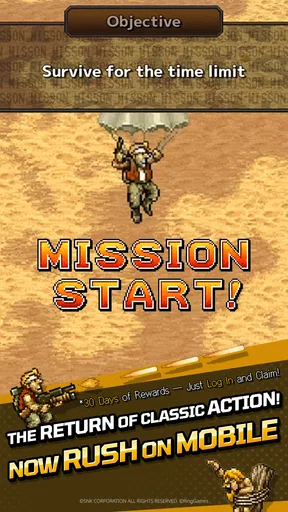
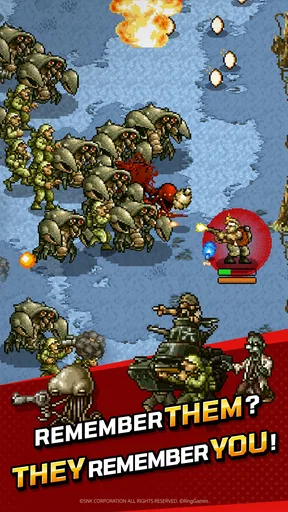
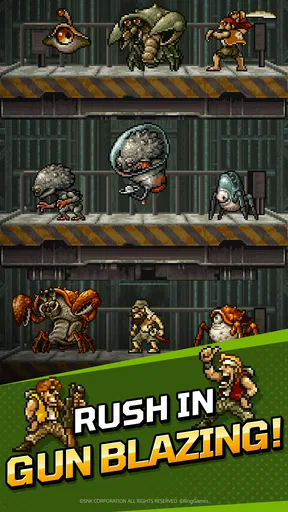
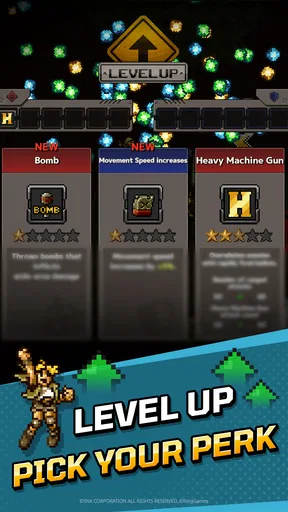
 Analysis by AppCompare
I went into METAL SLUG RUSH expecting a quick action game with familiar arcade energy, and that is exactly where it makes the strongest impression. It takes the recognizable run-and-gun spirit associated with classic Metal Slug and places it inside a survival-focused structure built around leveling up and shaping each attempt. My overall view is positive but measured: this is an accessible action game for short sessions, yet it is not automatically the best choice for someone looking for a deep campaign, precise arcade recreation, or a completely friction-free free-to-play experience.
The central appeal is easy to understand. You enter a run, fight through danger, collect progress, and make decisions that influence how that particular attempt develops. That format gives the game a useful rhythm for mobile play. I can start it when I have only a few minutes, but I still have a reason to pay attention because the choices made during a run affect how confidently I can handle what comes next.
It is also worth setting expectations early. The game is free to download, carries an Everyone 10+ content rating, and comes from revivecontents. Its current version is 1.0.5, and it requires Android 6.0 or later. Those details make it broadly approachable, but the published average of 3.0 from around 1.1 thousand ratings suggests that the experience is not equally convincing for everyone. I would treat it as a game to try rather than an automatic recommendation for every action fan.
Why the run-based action works
The best part of METAL SLUG RUSH is the way it turns a familiar action premise into a repeatable decision-making loop. Traditional arcade action often asks you to memorize patterns, improve movement, and survive a fixed sequence. Here, the roguelite structure gives each attempt its own momentum. Even when a run ends, the experience can feel useful because I have learned which threats deserve immediate attention and which upgrades support my preferred approach.
That makes the game more approachable than a strictly old-school arcade challenge. I do not need to commit to a long session or master every stage before seeing progress. A short attempt can still produce a satisfying lesson. If I am playing during a commute or waiting for an appointment, I can focus on one run instead of needing a large uninterrupted block of time.
The Metal Slug influence also gives the presentation a clear identity. The appeal is not simply “another survival game”; it is the combination of explosive action, fast reactions, and a recognizable military-cartoon tone. That distinction matters because mobile action games can otherwise blur together. The classic inspiration gives this one a more specific personality, even though the roguelite format changes how that personality is delivered.
I found the progression most enjoyable when I treated each attempt as an experiment rather than as a test I had to win immediately. A common mistake is to choose upgrades only because they look powerful in isolation. A better approach is to consider how they work together. If one choice helps with crowd control, another may be more valuable when it improves survival during the moments when enemies surround you. The useful question is not “Which upgrade is strongest?” but “Which option solves the problem I am currently facing?”
Worth Reading Before You Choose

EA SPORTS FC Mobile 26 Is a Bigger Football Game, but It Takes Time

Flipboard Shows What News Apps Must Do Beyond the Feed

Switching to Android Auto Means Rethinking Your Driving Routine

Google Calendar Makes a Crowded Week Easier to Manage

Ludo King Makes the Most of the Minutes Between Plans

Baby Panda World Brings Quick Play to Modern Phones, but Its Game Library Feels Busy
That small change in thinking is one of the game’s more meaningful strengths. It gives the action a layer of planning without making the game feel like a complicated strategy title. I can still play instinctively, but paying attention to the shape of a run produces better results. Players who enjoy adapting to imperfect options will probably get more from it than players who want to follow one fixed build every time.
How I would approach a first session
For a new player, I would avoid chasing maximum damage immediately. Early runs are more useful when they reveal how quickly danger builds and how much room there is to move. I would first watch the edges of the screen, keep a safe escape route open, and notice whether enemies are more threatening in groups or through individual attacks. This sounds basic, but survival games often punish tunnel vision more than slow damage output.
I would also resist spending every available resource as soon as it appears. Saving a useful option for a difficult section can be more valuable than taking a minor improvement just because it is available. The game’s run-based structure rewards flexible thinking, and that means accepting that a slightly weaker choice now may create a safer path later.
Another practical tip is to use short sessions deliberately. Because the game is built around repeated attempts, playing for ten focused minutes can be more productive than playing while distracted for much longer. If I am checking messages, rushing through choices, or playing with half my attention, the action becomes more frustrating than it needs to be. The game is at its best when I give each run enough concentration to recognize patterns and make deliberate selections.
The strongest evidence in everyday play
The clearest use case is a player who wants action without the commitment of a full console-style campaign. Imagine having a short break between tasks. A traditional platform shooter may ask you to remember a level layout and reach a checkpoint, while a large action role-playing game may bury the session under menus and travel. This game offers a more direct alternative: start a run, make a few choices, react to enemies, and stop when the session naturally ends.
That convenience does not mean the game is mindless. Its strongest moments come when the screen becomes busy and I have to decide whether to push forward, reposition, or prioritize a particular threat. The run structure makes those moments feel personal because the build I created influences how I respond. A different set of choices can make the same kind of danger feel manageable or overwhelming.
It also suits players who enjoy gradual improvement but do not want a purely competitive experience. The satisfaction comes from understanding the game better, not only from clearing a fixed stage. I can improve my timing, learn when to take risks, and recognize which decisions leave me vulnerable. That learning curve is more forgiving than a rigid arcade ladder, although it may feel less precise to someone who wants every challenge to be identical from one attempt to the next.
The game has already attracted over 100 thousand installs, which gives it a meaningful audience for a relatively focused mobile action release. Its rating, however, is a reminder to keep expectations realistic. Popularity does not guarantee polish or universal appeal. I would read the install count as evidence that the concept has found interested players, not as proof that every part of the experience will satisfy a Metal Slug purist.
Where the free-to-play model changes the experience
The most important limitation is that the game is free but includes in-app purchases ranging from $0.99 to $104.99 per item. That wide range affects how I evaluate the experience, even if a player can begin without paying. Free access is helpful for testing the combat and deciding whether the run loop suits you, but the presence of purchases means the long-term experience deserves more attention than the opening minutes.
For me, the sensible approach is to play without spending until the basic loop proves that it deserves a place on my phone. In a game based on repeated runs, a purchase can feel tempting after a difficult attempt or during a slow stretch of progress. I would make that decision only after identifying a specific source of enjoyment, not simply because a run ended badly. Paying to remove frustration is rarely a good sign that the game has earned the money.
This is also where the game may lose players who prefer a clean premium experience. If your ideal action game is something you buy once and then enjoy without purchase prompts or progression concerns, a free-to-play roguelite may feel less comfortable. A conventional paid arcade title would be a better fit for that preference, even if it offers less replay variety.
The trade-off is understandable: free entry lowers the barrier to trying the game, while purchases can become a source of friction for players who dislike monetized progression. I would not dismiss the game solely because of that model, but I would keep spending strictly optional in my own play and judge the title primarily by how enjoyable its no-cost loop feels.
Who should play it, and who should skip it
I would recommend this game to fans of compact action sessions, survival-style runs, and upgrade choices that change the way an attempt develops. It is especially suitable for someone who likes the idea of Metal Slug’s energetic combat but wants a format that can be replayed in short bursts instead of a fixed sequence of stages. Players who enjoy learning through failure should find a natural rhythm here.
It is also a reasonable choice for a younger audience within the Everyone 10+ rating, provided the player is comfortable with action violence presented in a stylized game setting. The rating makes it more broadly accessible than many darker action releases, while the fast pace keeps it from feeling like a slow, story-heavy adventure.
I would be more cautious recommending it to competitive players who need exact balance, deep multiplayer systems, or a clear long-term ranking goal. I would also point elsewhere if your main reason for downloading is to replay the original Metal Slug experience as faithfully as possible. The roguelite survival structure changes the priorities: repeated builds and adaptation matter more than simply reproducing a classic stage-by-stage campaign.
Likewise, people who dislike repeated attempts may run into the game’s biggest philosophical obstacle. The format expects failure to be part of the process. If restarting feels like wasted time rather than another opportunity to improve, the core loop may become tiring quickly. In that case, a linear action game with permanent levels and predictable progression would be a better match.
What the store details mean in practice
The game is listed in the action category, which is accurate, but that label does not fully explain its pace. It is not just a reflex test and not just a character-building game. The appeal sits between those two ideas. You need enough awareness to survive immediate threats, while also making choices that shape the rest of the run.
The developer, revivecontents, has kept the concept focused rather than presenting it as a broad collection of unrelated modes. That focus is useful because I always know what the game wants me to do: enter the action, make progress, and improve my next attempt. The downside is that anyone looking for a wide variety of side activities may find the experience narrower than larger mobile action games.
Its release date is Jun 13, 2026, and the current version is 1.0.5. I would therefore approach it as a relatively early version of a game whose long-term appeal may depend on how well its run structure continues to hold attention. That does not make it a poor download, but it does reinforce my advice to judge the fundamentals first: movement, combat clarity, upgrade decisions, and whether restarting feels rewarding rather than repetitive.
My final verdict
METAL SLUG RUSH succeeds when it keeps the action moving and gives each run a reason to feel different. Its strongest qualities are the approachable session length, the recognizable arcade flavor, and the way upgrades encourage adaptation instead of passive repetition. I especially like that it can work as a quick break-time game while still offering enough decision-making to reward attention.
Its weaknesses are just as relevant. The average rating of 3.0 shows that the experience has not landed perfectly for its audience, and the free-to-play purchase range may be uncomfortable for players who want a straightforward premium game. The run-based structure can also become repetitive if you do not enjoy experimenting after failure.
My recommendation is to try it if you want a free action game that blends classic run-and-gun energy with survival-style replayability. Keep your expectations focused on short, repeatable runs rather than a complete remake of an arcade campaign, and decide early whether the no-cost experience is satisfying on its own. For that specific audience, it is worth a look. For players seeking a polished one-time purchase, a faithful classic, or a deep competitive system, I would choose a different kind of action game.
Pros
- Fast-paced controls make short play sessions enjoyable.
- Classic Metal Slug visuals and sound effects feel authentic.
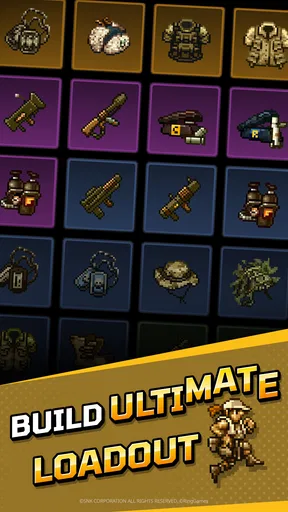
- Many unlockable characters and upgrades add progression.
- Runs well on most modern Android and iOS devices.
- Simple controls make it accessible for casual players.
Cons
- Energy limits can interrupt longer gaming sessions.
- Upgrade costs may encourage repetitive grinding.
- Some stages become predictable after repeated runs.
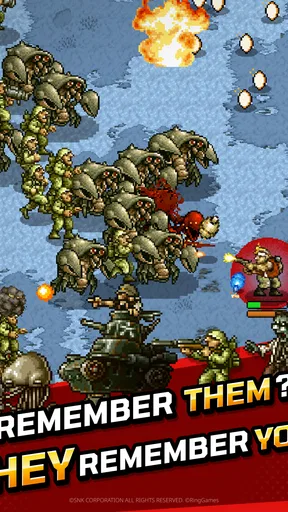
- The small screen can make crowded battles hard to read.
- Online features may depend heavily on a stable connection.
FAQs for METAL SLUG RUSH
What is METAL SLUG RUSH, and how does the gameplay work?
METAL SLUG RUSH is a fast-paced action game inspired by the classic METAL SLUG series. It focuses on quick runs, constant shooting, enemy waves, bosses, and collectible upgrades. Instead of offering only traditional arcade stages, the game adds progression elements that encourage you to improve your character, weapons, and abilities as you advance through increasingly challenging missions.
Can METAL SLUG RUSH be played offline?
Some parts of METAL SLUG RUSH may be available without a continuous internet connection, but online access can be required for downloading game data, synchronizing progress, receiving updates, and using certain events or competitive features. Availability may also depend on the version installed and the developer’s current service requirements, so it is best to launch the game online at least once after installation.
Is METAL SLUG RUSH free to download and play?
METAL SLUG RUSH can generally be downloaded without an upfront purchase, but it may include optional in-app purchases. These can provide virtual currency, upgrades, extra resources, or other convenience items. You can usually progress by playing normally, although some improvements may take time to unlock. Parents should also review purchase settings if children use the device.
Does METAL SLUG RUSH support multiplayer or competitive modes?
The main experience is built around action-focused missions, but the game may also include online events, rankings, challenges, or other features that compare your progress with other players. The exact modes can change through updates and regional releases. Check the in-game menus after installation to see which competitive or social options are currently active on your device.
What devices are recommended for playing METAL SLUG RUSH smoothly?
METAL SLUG RUSH is designed for modern Android and iOS devices, but performance can vary depending on the phone or tablet’s processor, memory, operating-system version, and available storage. Older devices may experience longer loading times, reduced visual quality, or occasional slowdowns during busy battles. Keeping the system updated and closing background apps can help improve stability.


